


Beyond Thailand's white sandy beaches and the fragrant spice of Tom Yum soup lies a deeper story. The country's true soul is found in the details — like its currency. From ancient cowrie shells to the first paper banknotes, let's peek into the purse of history and see how the people of Siam paid their way centuries ago.
Ancient Means of Payment
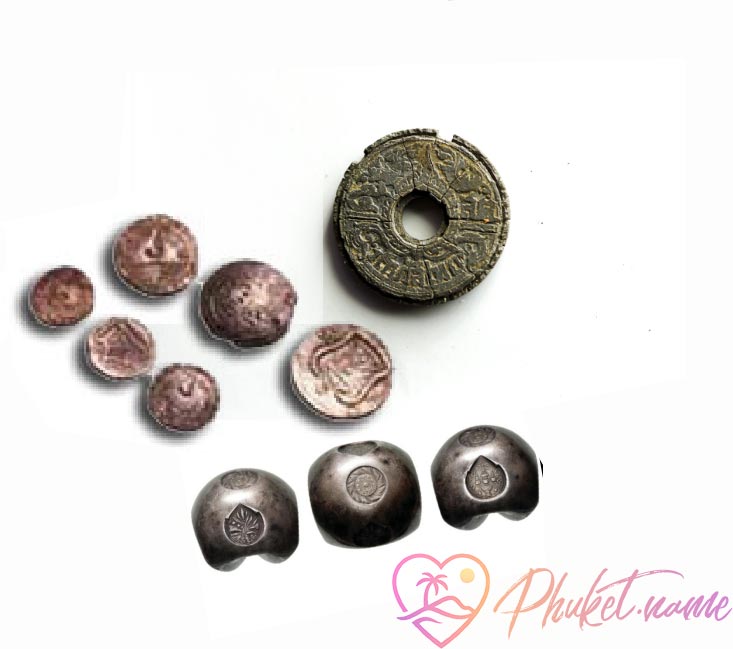
Cowrie Shells, Prakap, Photduang, Pi Kra Buang, and Coins
Before banknotes were introduced alongside other forms of currency into the country's financial system, the Thai people used cowrie shells, Prakap (baked clay with an impressed seal), Photduang silver bars (bullet coins), Pi Kra Buang porcelain tokens, and minted coins as mediums of exchange.
It was not until the reign of King Mongkut (Rama IV) that diplomatic relations were established with foreign nations and trade liberalization occurred, leading to economic expansion. The production of Photduang, the primary currency at that time, could not keep pace with demand. Furthermore, counterfeit Photduang began to circulate in the market, causing widespread problems and distress. Consequently, in 1853 (B.E. 2396), King Mongkut ordered the creation of the first type of paper money for use in the national currency system, known as "Mai."
-
Cowrie shells — Shell money, small seashells used as a medium of exchange in ancient times.
-
Prakap — Earthenware tokens with stamped seals, an ancient form of clay currency.
-
Photduang — Traditional boat-shaped silver bars, the primary metal currency of ancient Siam.
-
Pi Kra Buang — Porcelain tokens, often used as small change or substitutes for coins.
-
Mai — The name of Thailand's first paper money, literally meaning "stamp" or "mark."
2396 (1853)
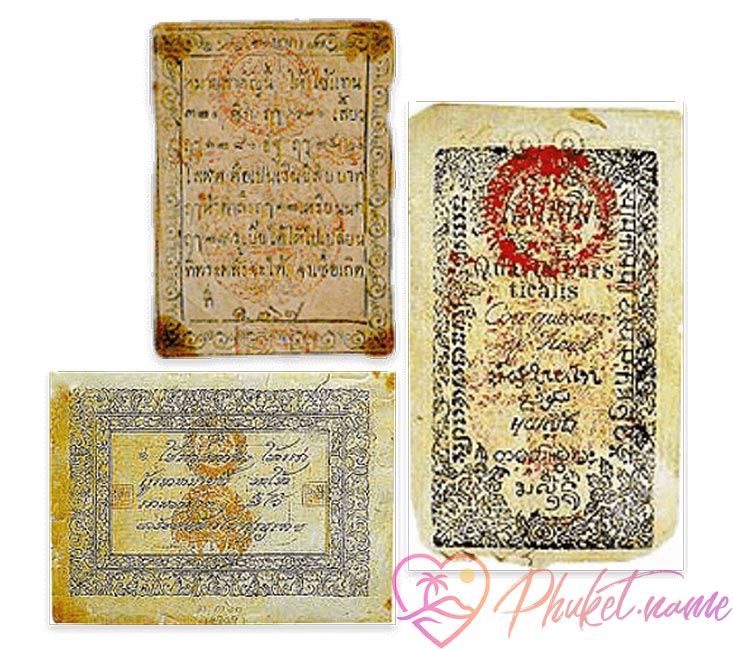
Mai (Stamped Paper Money)
It was made of white paper, with letters and patterns printed in black ink. To prevent counterfeiting, it was stamped with two seals in vermilion red: the royal emblem of the Chakri Dynasty depicting the "Phra Saeng Chak" (Diamond Disc/Chakra) and the king's personal royal seal depicting the "Phra Maha Phichai Mongkut" (Great Crown of Victory). Three types of Mai were ordered to be produced: low-denomination Mai, Tamluang-denomination Mai, and high-denomination Mai. However, because Mai was a new form of currency, while the people were still accustomed to the ancient metal currency, Photduang silver bars, it did not come into widespread use as the king had intended.
-
Mai (หมาย) — Thailand's first paper money; the name literally means "stamp" or "mark."
-
Phra Saeng Chak (พระแสงจักร) — The Diamond Disc (Chakra), a symbol of the Chakri Dynasty.
-
Phra Maha Phichai Mongkut (พระมหาพิชัยมงกุฎ) — The Great Crown of Victory, the personal royal seal of the king.
-
Tamluang (ตำลึง) — An ancient Thai unit of weight and currency (approximately 60 grams of silver).
-
Photduang (เงินพดด้วง) — Traditional boat-shaped silver bars, the primary metal currency of ancient Siam.
2415 – 2416 (1872 – 1873)
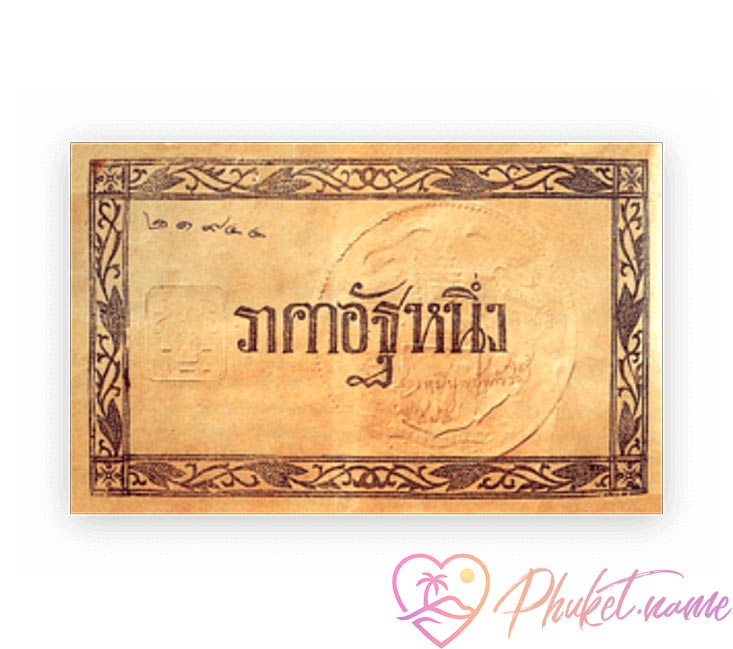
Att Paper Money
Later, between 1872 and 1873 (B.E. 2415–2416), during the reign of King Chulalongkorn (Rama V), a problem arose due to a shortage of low-denomination coins—small change made of tin and copper. At the same time, "Pi" tokens, which were used as substitutes for money in gambling dens, began to be used as a medium of exchange. In 1874 (B.E. 2417), King Chulalongkorn therefore ordered the production of low-denomination paper money called "Att Paper Money" for the public to use in place of the scarce coins. However, like the Mai banknotes before them, Att Paper Money did not gain widespread popularity.
-
Att (อัฐ) — A low-denomination unit of currency in ancient Siam.
-
Att Paper Money (อัฐกระดาษ) — Low-denomination paper money issued during the reign of King Rama V.
-
Pi (ปี้) — Tokens used in gambling dens as substitutes for cash, which were later illegally used as currency.
-
King Chulalongkorn (Rama V) — The fifth monarch of the Chakri dynasty, reigned 1868–1910, known for modernizing Siam.
2432, 2441, 2442 (1889, 1898, 1899)
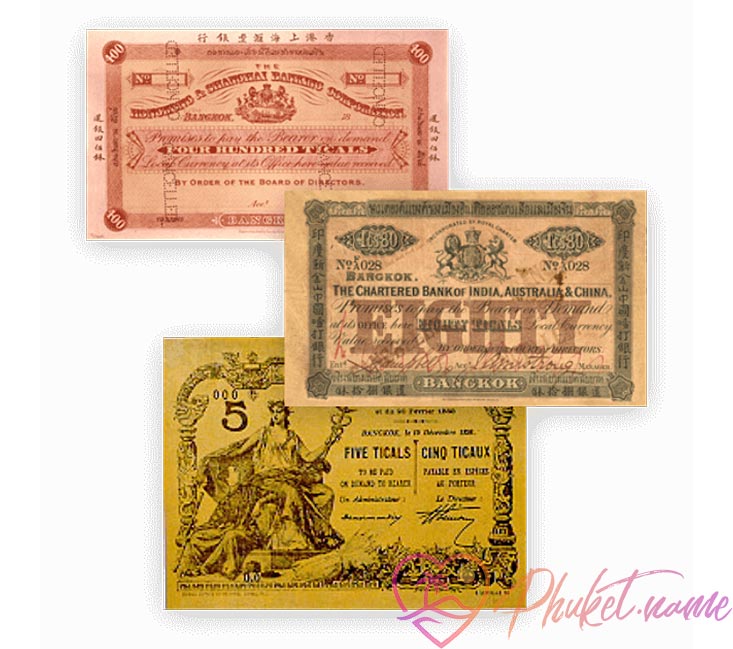
Bank Notes
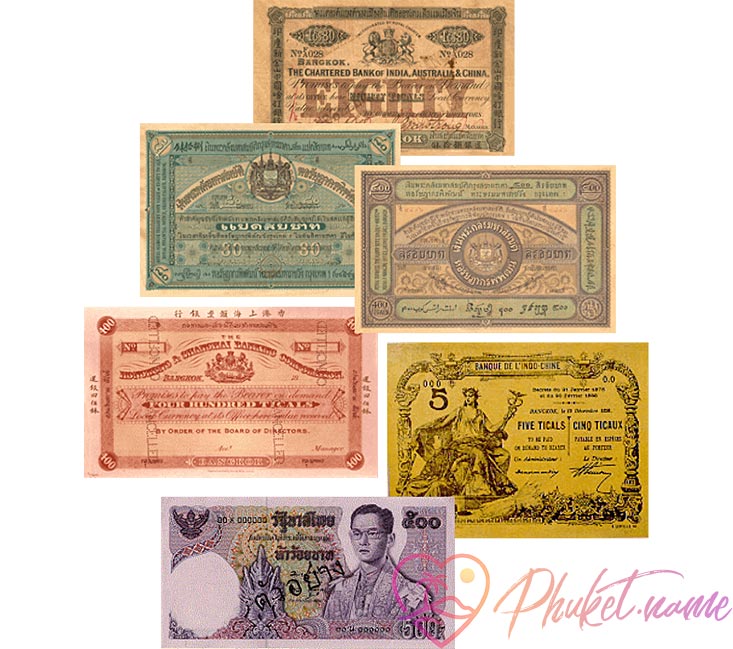
The next type of paper currency was bank notes issued by three foreign commercial banks that had opened branches in Thailand: the Hongkong and Shanghai Bank, the Chartered Bank of India, Australia and China, and the Bank of Indochina. They were granted permission to issue bank notes in 1889, 1898, and 1899 respectively. This was because, during that period, the government faced difficulties in minting coins quickly enough to keep pace with the expanding economy.
Bank notes were a type of promissory note used to facilitate debt settlements between the banks and their customers. Therefore, the circulation of bank notes was limited to a narrow circle of individuals who had business dealings with those particular banks. Nevertheless, bank notes helped familiarize the public with paper money. Moreover, because they were in circulation for more than 13 years (1889–1902), the transliterated terms "banknote" or simply "bank" became ingrained in Thai usage. This accustomed Thai people to calling the government banknotes issued later "bank" (แบงก์), a colloquial term that persists to this day.
-
Bank notes (บัตรธนาคาร) — Paper currency issued by commercial banks, not the government.
-
Hongkong and Shanghai Bank — Now HSBC, one of the first foreign banks in Thailand.
-
Chartered Bank of India, Australia and China — A predecessor of Standard Chartered Bank.
-
Bank of Indochina — A French colonial bank, predecessor of Banque Indosuez.
-
Promissory note (ตั๋วสัญญาใช้เงิน) — A financial instrument representing a promise to pay.
-
Bank (แบงก์) — Thai colloquial term for banknotes, derived from the English word "bank."
2432 (1889)
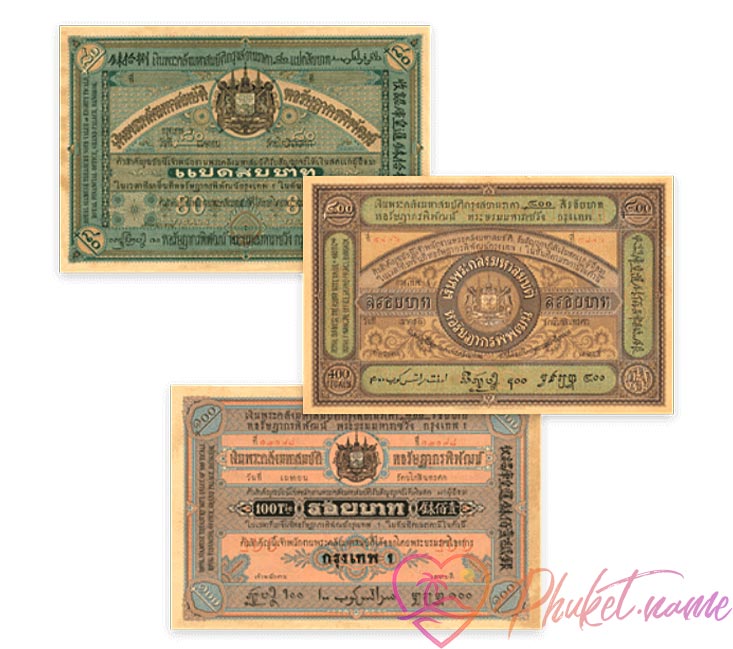
Royal Paper Money
Meanwhile, the government at that time considered that the bank notes being issued by the branches of foreign commercial banks were similar in nature to currency that the government should issue itself. Therefore, in 1890 (B.E. 2433), preparations began for the issuance of treasury bills by the Ministry of Finance, called "Royal Paper Money." An order was placed with the German firm Giesecke & Devrient to print eight denominations. The Royal Paper Money arrived in Bangkok in 1892 (B.E. 2435). However, due to the authorities' lack of preparedness in administration, the Royal Paper Money was never put into circulation.
-
Royal Paper Money (เงินกระดาษหลวง) — The first government-planned paper currency, intended to be issued by the Thai Ministry of Finance.
-
Ministry of Finance (กระทรวงพระคลังมหาสมบัติ) — The historical name for Thailand's Ministry of Finance.
-
Giesecke & Devrient — A renowned German security printing company specializing in banknotes and securities, still in operation today.
-
Eight denominations (๘ ชนิดราคา) — Eight different face values of the planned currency.
2445 (1902)
Government Banknotes
It was not until 1902 (B.E. 2445) that a significant milestone in the issuance of banknotes was reached. Specifically, King Chulalongkorn (Rama V) issued a royal command enacting the "Siamese Banknote Act, Ratanakosin Era 121" on June 24, 1902. He also graciously ordered the establishment of the "Banknote Department" under the Ministry of Finance, tasked with issuing banknotes and handling their receipt and disbursement. The exchange of metal currency for banknotes was opened to the public starting September 23, 1902. From that point onward, banknotes began to play a substantial role in Thailand's financial system.
The banknotes issued under the Siamese Banknote Act, Ratanakosin Era 121, took the form of government promissory notes, pledging to pay currency immediately to the bearer upon presentation. Later, during the reign of King Prajadhipok (Rama VII), the Currency Act of 1928 (B.E. 2471) was promulgated. This Act stipulated that the country's currency shall consist of banknotes and coins, and established both banknotes and coins as legal tender for the settlement of debts. This marked the complete transformation of banknotes from promissory notes into full-fledged currency.
-
Banknote Department (กรมธนบัตร) — The first government agency established to manage the issuance of banknotes, a precursor to the modern Bank of Thailand's note-issuing functions.
-
Siamese Banknote Act, Ratanakosin Era 121 (พระราชบัญญัติธนบัตรสยาม รัตนโกสินทรศก ๑๒๑) — Thailand's first law governing the issuance of government banknotes.
-
Ministry of Finance (กระทรวงพระคลังมหาสมบัติ) — The historical name for Thailand's Ministry of Finance.
-
Promissory note (ตั๋วสัญญาใช้เงิน) — A financial instrument representing a promise to pay.
-
Currency Act of 1928 (พระราชบัญญัติเงินตรา พุทธศักราช ๒๔๗๑) — The law that fully established banknotes as legal tender alongside coins.
-
Legal tender — Currency that must be accepted if offered in payment of a debt.

Copyright Notice
All banknote images and textual content displayed on the website are the copyrighted property of the Bank of Thailand and are protected under the Copyright Act B.E. 2537 (1994). The use of any images or information for commercial purposes must be authorized by a written/formal permission from the Bank of Thailand.