


Pollution Control Department Reaffirms Commitment to Environmental Safety and Oversees Use of Oil Spill Dispersants Following Sinking of Panamanian Cargo Vessel off Phuket
Mr. Surin Worakitthamrong, Director-General of the Pollution Control Department (PCD), reported regarding the incident on February 7, 2026, when a Panamanian cargo vessel sank at sea in Phuket Province. The presumed cause is a leak in the vessel's hull, allowing water to enter the hull and leading to its sinking. On board the vessel were 297 units of "dry cargo in containers," 98 tons of heavy fuel oil, and 32 tons of marine diesel oil.
The Pollution Control Department plays a key role in supervising, monitoring, and regulating the use of chemical agents to neutralize oil spills in Thailand, in accordance with the National Plan for the Prevention and Elimination of Water Pollution by Oil of 2002. This ensures appropriate responses to oil spills that do not cause harm to the environment or public health.
Chemical dispersants are substances composed of surfactants and solvents. They work by breaking down the oil slick on the water's surface into small droplets and allowing them to disperse into the water column. The goal is to remove the oil from the surface as quickly as possible, transferring it into the water mass, leading to rapid water purification to safe concentrations. After this, the oil undergoes natural biodegradation. The use of dispersants in Thai water bodies is permitted only for agents approved by relevant domestic and international government agencies, listed in the PCD-established inventory, and under PCD supervision. Applying dispersants requires written permission from the PCD in the following areas:
(1) Marine areas with a depth of less than or equal to 10 meters.
The permit application review process includes assessing the suitability of the dispersant type and quantity against the type and volume of spilled oil. Typically, a dispersant-to-oil ratio of approximately 1:10 is used, alongside a Net Environmental Benefit Analysis (NEBA), to ensure that dispersant application optimally reduces the impact on natural resources, ecosystems, and the overall environment.
In the case of the sinking of the Panamanian cargo vessel SEALLOYD ARC PANAMA at sea off Phuket Province, the PCD used the Oil Map mathematical model to predict the movement direction of any potential oil slick. The simulation indicated that an oil slick would move from the vessel's sinking location in a southwest direction and drift out to the open sea, not approaching the Thai coastline. The depth at the sinking location is approximately 60 meters. Operational units can apply dispersants without needing prior permission from the PCD. However, they are required to prepare a final report on the dispersant application and submit it to the PCD for acknowledgment after the operation is complete.
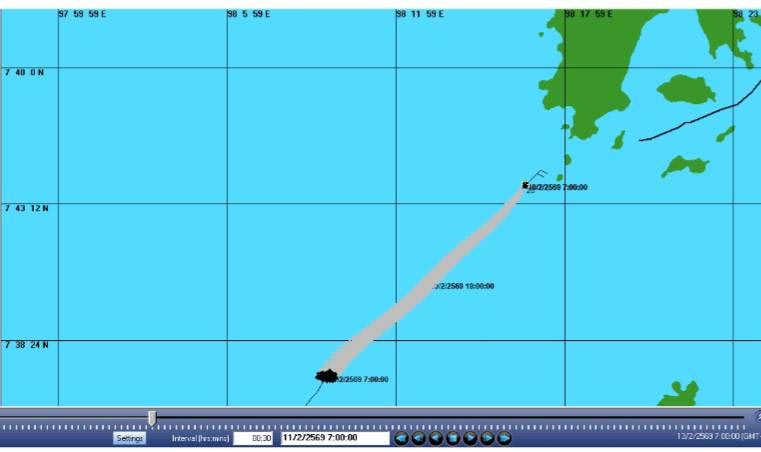 Potential oil spill zone
Pollution Control Department Issues Announcement "On Recommendations for the Public in Case of Finding Containers with Hazardous Substances from the Sunken Panamanian Cargo Vessel SEALLOYD ARC, B.E. 2569 (2026)"
Following the incident on February 7, 2026, at approximately 3:30 p.m., when a container cargo vessel named SEALLOYD ARC, sailing under the Panamanian flag, with a gross tonnage of 4,339 tons, length of 113 meters, and width of 16 meters, sank in the area southwest of Khao Noi Island, Phuket Province. The depth at the sinking site is 61 meters, coordinates: latitude 7° 43.88″ North, longitude 98° 16.62″ East. The seabed is sandy with silt; the vessel has a slight list. After the sinking, the 297 containers on board floated and scattered around the area near the specified coordinates.
The Director-General of the Pollution Control Department, acting under the authority granted by Article 32 of the State Administrative Organization Act B.E. 2534 (1991) and its amendments, issues the following recommendations and procedures for action upon finding containers of unknown origin on the beach or at sea:
-
Do not approach the suspicious container; maintain a distance of at least 50 meters. It is strictly forbidden for citizens, tourists, or unauthorized persons to approach them.
-
Do not open suspicious containers found on the beach or at sea, especially those with markings and symbols indicating danger, as shown in the appendix to this announcement.
Do not touch any liquids, oil slicks, or lumps of chemical substances leaking from the container, as they may be corrosive or able to penetrate the skin.
Do not smoke or perform any actions that could cause a spark or use an open flame near the area, as many chemical substances in cargo containers are flammable. Also, refrain from operating engines in areas with a chemical odor.
The public is requested, upon discovery, to photograph the container and any hazard signs (if present), record the location of the find, and contact the relevant authorities via the hotline telephone numbers:
- 1650 (Pollution Control Department)
1196 (Marine Department)
1465 (Marine Interests Protection Center)